

How Much G-Force Can The Human Body Withstand?
SHARE THIS POST:
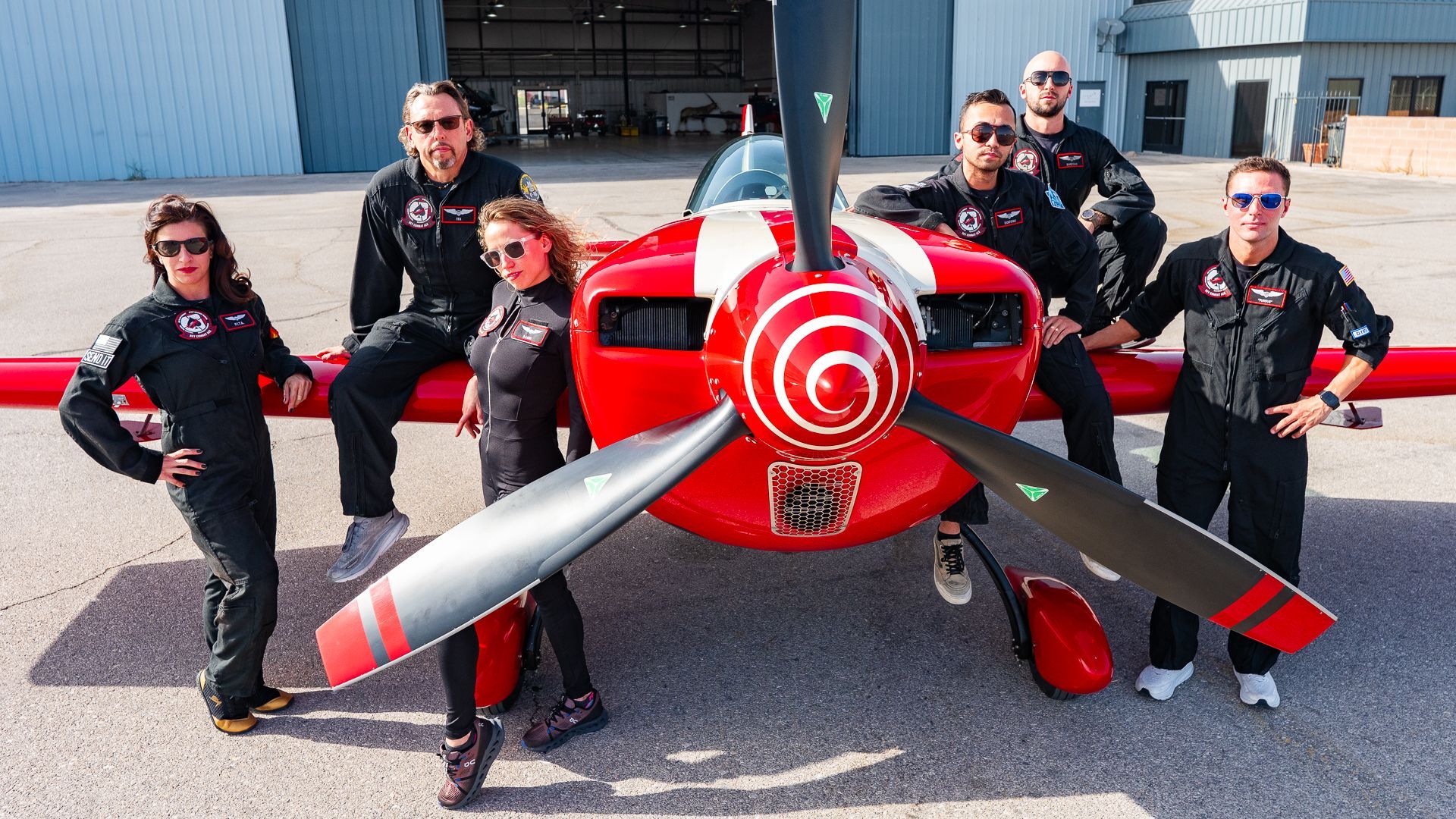
The short answer: most people can handle 2 to 5 Gs without any special training. Trained fighter pilots wearing G-suits can sustain around 9 Gs. The highest G-force a human has survived in a controlled test is 46.2 Gs, held for a fraction of a second by Air Force Colonel John Stapp on a rocket sled in 1954.
That is the number everyone searches for. The more interesting question is what those forces actually do to your body, and how many of them you can experience yourself over the Las Vegas desert. Our Las Vegas stunt flying team pulls Gs for a living, so here is the full picture.
What Is a G, Exactly?
The G in G-force stands for gravity. It is a measure of acceleration: how fast your speed or direction is changing. Sitting still reading this, you are at exactly 1 G. That is Earth's gravity pulling on you. Accelerate hard and the force multiplies. At 2 Gs your body feels twice as heavy. At 4 Gs a 180 pound person effectively weighs 720 pounds.
On a typical commercial flight you never feel more than about 1.3 Gs or less than about 0.7 Gs, which is why most passengers barely notice. Stunt planes and fighter jets live in an entirely different range.
G-Force by the Numbers
| G level | What produces it |
| 1 G | Standing still on Earth |
| 1.3 G | A commercial jet climbing or turning |
| 3 to 4 G | The biggest drops on major roller coasters, briefly |
| Up to 4 G | An aerobatic ride with Sky Combat Ace, at your request |
| 9 G | Fighter pilots in hard combat maneuvers, with G-suits |
| 10 to 12 G | What a stunt plane's airframe is built to take |
| 46.2 G | The record: Colonel John Stapp's 1954 rocket sled stop |
What Each G Level Feels Like
2 Gs: your arms and head feel heavy, like the moment a fast elevator starts. Cameras droop. Smiling takes work. Almost everyone finds 2 Gs fun rather than uncomfortable.
3 Gs: your body weighs three times normal. Lifting your hand off your lap takes real effort and your cheeks start pulling down. This is a big roller coaster at the bottom of its steepest drop, held a little longer.
4 Gs: the classic aerobatic range. Vision may narrow slightly at the edges as blood is pulled toward your legs. Your instructor will teach you to tense your legs and core, and the feeling is intense but manageable for a healthy person.
5 to 6 Gs: without training, most people start to grey out here. Peripheral vision fades to a tunnel because the heart struggles to push blood up to the brain against the force.
9 Gs: fighter pilot territory. Only conditioning, a straining technique, and an inflating G-suit keep a pilot conscious. An untrained passenger would black out in seconds.
What Happens When It Is Too Much?
Sustained downward G-force drains blood from your head toward your legs. The progression is predictable: first greyout, where color and peripheral vision fade. Then blackout, where vision goes dark while you are still conscious. Then G-LOC, short for G-induced loss of consciousness, where the brain simply shuts down for several seconds until blood pressure recovers. We wrote a full explainer on what G-LOC is and how pilots avoid it.
Negative Gs, the kind you feel hanging against the straps in outside maneuvers, push blood the other way, toward the head. The body tolerates far less in that direction, which is why even aerobatic pilots treat sustained negative G with respect.
The Most Gs a Human Has Ever Survived
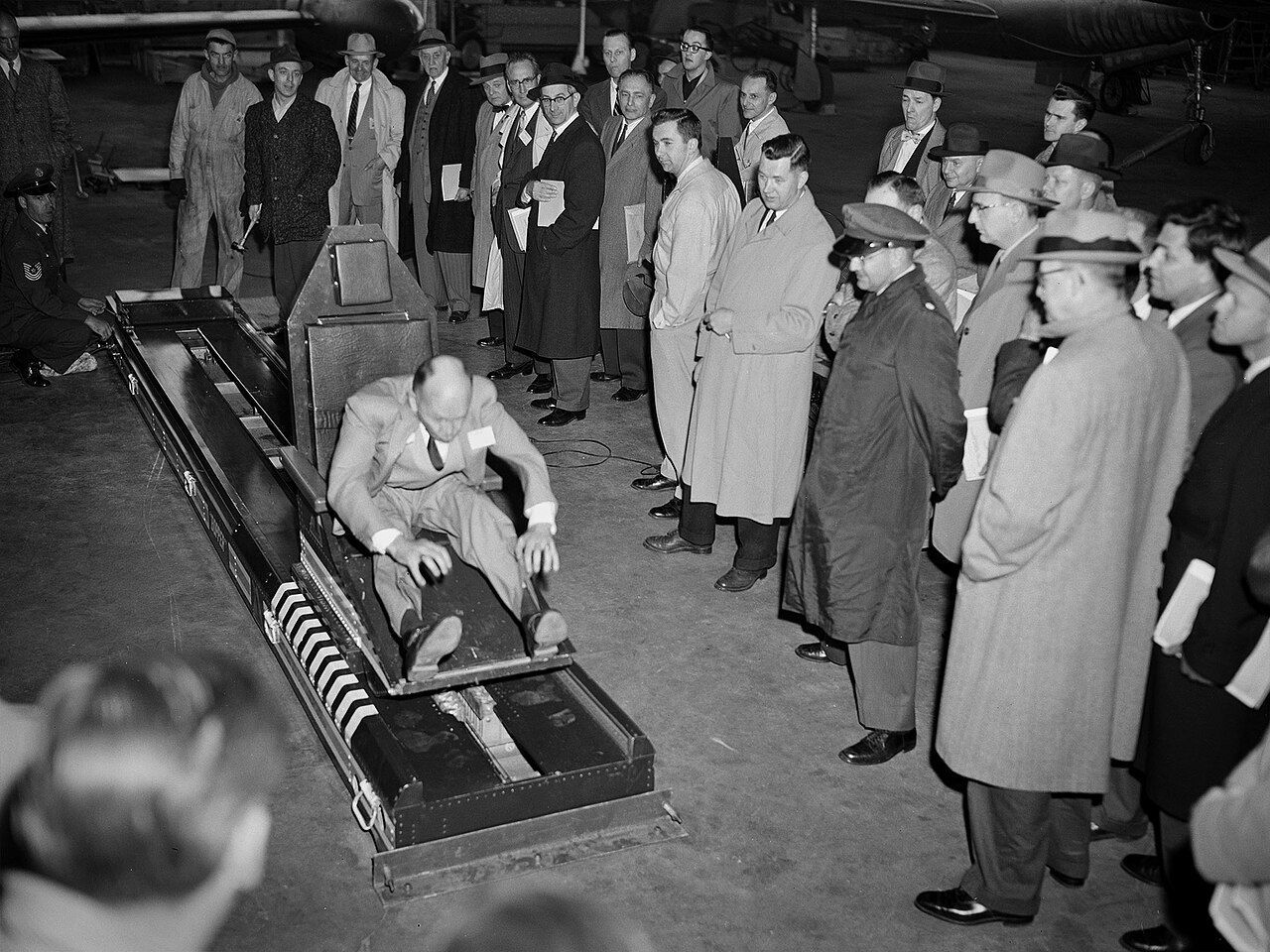
On December 10, 1954, Air Force flight surgeon Colonel John Stapp strapped himself to a rocket sled at Holloman Air Force Base in New Mexico, accelerated to over 600 miles per hour, and slammed into a water brake that stopped him almost instantly. The deceleration peaked at 46.2 Gs. Stapp survived with burst blood vessels in his eyes and bruising from the harness, and his data still underpins ejection seat and seat belt design today. The lesson from his work: the human body can take enormous G-forces for a fraction of a second. It is sustained G-force, held for multiple seconds, that the body cannot fight.
How Fighter Pilots Handle 9 Gs
Two tools make 9 Gs survivable. The first is technique: pilots clench their legs, glutes, and core while breathing in short, forceful bursts, which physically traps blood in the upper body. The second is the G-suit, a garment with air bladders that automatically inflate against the legs and abdomen during hard maneuvers, squeezing blood back toward the brain. Add years of physical conditioning and a pilot can stay sharp through forces that would put an untrained person to sleep.
Does a Faster Plane Mean More Gs?
No, and the extremes make the point. The SR-71 Blackbird, the fastest jet ever built at nearly 2,200 miles per hour, was limited to about 3 Gs. An Extra 300 stunt plane tops out just over 200 miles per hour yet routinely pulls 10 Gs, because G-force comes from how sharply you change direction, not how fast you are going. A tight loop in a nimble stunt plane out-pulls a spy jet in a straight line every time.
How Many Gs Will You Pull Over Las Vegas?
Our stunt planes are built for up to 12 Gs, but the flight is built around you. Most guests without special training are comfortable between 2 and 5 Gs, and our flights rarely exceed 4 Gs unless you ask for more. You tell your pilot how far to push it: a smooth scenic ride, a solid 4 G loop, or a max-performance run that flirts with greyout for the true adrenaline chasers. Every flight is flown with an FAA certified instructor, no experience needed, and you actually take the controls yourself. If that sounds like your kind of day, see how it stacks up against every other thrill in town in our Vegas adrenaline guide. Flying one yourself also sits high on our Ultimate Las Vegas Bucket List, next to 24 other once in a lifetime experiences.
Frequently Asked Questions
How many Gs can a human survive?Most people handle 2 to 5 Gs without training. Trained fighter pilots with G-suits sustain about 9 Gs. For a split second, the body can survive far more: the record is 46.2 Gs. |
How many Gs is lethal?There is no single lethal number because duration matters more than the peak. Sustained forces above roughly 9 to 10 Gs are dangerous even for trained pilots, while John Stapp survived 46.2 Gs that lasted only a fraction of a second. |
What does 2 Gs feel like?Twice your body weight. Arms feel heavy, your face pulls down slightly, and holding a phone up for video becomes a workout. Nearly everyone finds it thrilling rather than unpleasant. |
Can a normal person handle 4 Gs?Yes. A healthy adult with no training can handle 4 Gs, which is why our aerobatic flights are flown in that range. Your pilot teaches you a simple muscle-tensing technique before you fly. |
Do I need experience to fly a stunt plane in Las Vegas?No. At Sky Combat Ace every flight is instructional, flown with an FAA certified instructor under federal aviation regulations, and you take the stick yourself on day one. |
Find Out How Many Gs You Can HandleFly a real stunt plane over the Las Vegas desert with a fighter pilot instructor. You set the intensity, from scenic to full afterburner-for-the-soul.
|
Check These Out Next:
Fly A Real Stunt Plane!
Sky Combat Ace was created by a U.S. Air Force veteran fighter pilot who wanted to make the thrill of flying fighter jets available to anyone who feels the need for speed.
Learn to fly a stunt plane under the supervision of our highly trained, FAA certified flight instructors. No experience necessary and YOU get to fly the plane!